


Our story, gure historia
Beneath the sea off the coast of Bizkaia lies the world’s first submarine winery and artificial reef. This is our story, and it began as a scientific experiment.
_
Beneath the sea off the coast of Bizkaia lies the world’s first submarine winery and artificial reef. This is our story, and it began as a scientific experiment.
Our story
2006–2008 · LSEB Plentzia is founded
It all began with LSEB Plentzia (Underwater Beverage Ageing Laboratory), the
world’s first underwater laboratory dedicated to studying how beverages evolve on the seabed. We were inspired by bottles found in ancient shipwrecks, which surprised us with their excellent preservation and flavour. We wanted to study wine above all, but also beer and cider. Simply obtaining permission to install it took us two years, from 2006 to 2008.
2008–2009 · We design the laboratory
Under the direction of Borja Saracho, we brought together biologists, engineers, winemakers, telecommunications experts and
professional divers to design the laboratory. We set ourselves three objectives: protect the bottles, avoid pollution and generate marine life.
2010 · We descend to the seabed
We installed our first MEC modules (Monitoring, Ageing and Control) on the seabed of Plentzia Bay, at a depth of 20 metres. They were equipped with sensors and cameras that sent data to the surface in real time. In September, we began a 12-month study. A small artificial reef began to form around the modules.
2011 · The sea delivers its verdict
In September, we uncorked beverages from 27 wineries across 14 Designations of Origin, after a year beneath the Cantabrian Sea, and the result was excellent. We studied the evolution of the beverages, corks and closures, as well as the life that had established itself on the reef. Everything confirmed that the sea brings something unique. In November, Crusoe Treasure was born.
2012 · We expand the reef
At the same location, we added eight new structures to the reef to begin commercial production.
2013 · We enter the market
We put our first wines on sale. We also signed an agreement with the University of Alicante to study the winery’s marine biology. 2014–2016 · A reef teeming with life
The vintages began to alternate: the new ones descended to the seabed while the older ones rose to the surface. Previously, the currents in the estuary caused the seabed to shift from sand to rock every few months, meaning that almost no species could settle there. Our structures gave marine life a stable foundation, and today more than 1,500 species live on the reef. We have even found shark eggs.
2017–2018 · Heading out into the world
We grew from 7,000 bottles in 2017 to 20,000. Our wines reached Belgium, China, Switzerland, Germany and Japan.
2020 · Weathering the storm
The pandemic hit us hard, and we went through a very difficult time because some of our international distributors and importers closed. We responded by launching online sales through our own website.
2024 · A new reef at Punta Galea
We built a new artificial underwater reef off Punta Galea, at a depth of around 28 metres. It functions both as a reef and as a winery.
2025 · Bubbles born at sea
We created the first sparkling wine to undergo its second fermentation beneath the sea, after almost two years underwater.
2026 · We arrive in Getxo
We opened our new space and showroom at the Getxo Marina, covering nearly 1,000 m². This is where you are right now. Welcome!
Today
We are one of the world’s pioneering underwater wineries and among the first to obtain
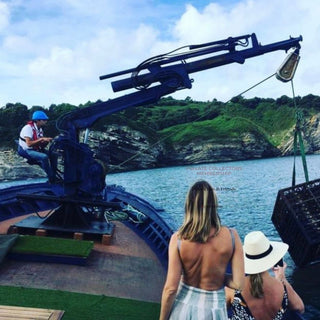
a legal concession and health registration. We organise onboard tastings and dives at the winery, while continuing to explore what the sea can bring to wine.
Thank you for joining us on this adventure.
Our story
2006–2008 · LSEB Plentzia is born
It all began with LSEB Plentzia (Underwater Beverage Ageing Laboratory). It was the world's first underwater laboratory, created to study how beverages evolve on the seabed. We were inspired by bottles found in ancient shipwrecks, which appeared to be exceptionally well preserved and full of flavour. We primarily wanted to study wine, but also
beer and cider. Simply obtaining permission to install it took us two years, from 2006 to 2008.
2008–2009 · Designing the laboratory
Under the direction of Borja Saracho, we brought together biologists, engineers, oenologists, telecommunications experts and professional divers to design the laboratory. We set ourselves three goals: to protect the bottles, avoid pollution and create marine life.
2010 · We descended to the seabed
We placed our first MEC modules (Monitoring, Ageing and Control) on the seabed of Plentzia Bay, at a depth of 20 metres. They contained sensors and cameras that transmitted data to the surface in real time. In September, we began a 12-month study. A small artificial reef began to form around the modules.
2011 · The sea's verdict
In September, we uncorked beverages from 27 wineries across 14 Designations of Origin after a year in the Cantabrian Sea, and the result was outstanding. We studied the evolution of the beverages, the corks and closures, and the life that had settled on the reef. Everything confirmed that the sea gives them something special. In November, Crusoe Treasure was born.
2012 · We expanded the reef
At the same location, we added eight new structures to the reef to begin commercial production.
2013 · To market
We put our first wines on sale. We also signed a collaboration agreement with the University of Alicante to study the winery's marine biology.
2014–2016 · A reef teeming with life
Harvests began to alternate: new ones descended to the seabed while older ones rose to the surface. At first,
the estuary's currents changed the seabed from sand to rock every few months, and almost no species could settle there. Our structures provided a stable foundation for marine life, and today more than 1,500 species live on the reef. We have even found shark eggs.
2017–2018 · Looking to the world
We grew from 7,000 bottles in 2017 to 20,000. Our wines reached Belgium, China, Switzerland, Germany and Japan.
2020 · Weathering the storm
The pandemic hit us hard, and we went through a very difficult period because some of our international distributors and
importers closed down. We launched online sales through our own website.
2024 · New Galea reef On the headland, we built a new artificial underwater reef opposite Galea Headland, at a depth of around 28 metres. It functions as both a reef and a winery.
2025 · Bubbles born at sea
We produced the first sparkling wine to undergo a second fermentation underwater, after spending almost two years beneath the surface.
2026 · We arrive in Getxo
We opened our new space and showroom at Getxo Marina, spanning almost 1,000 m². This is where you are now.
Welcome!
Today
We are one of the world's pioneering underwater wineries, and were among the first to obtain a legal concession and health registration. We organise tastings on board and diving trips to the winery, and continue to explore what the sea can bring to wine.